
tl;dr
This serious game shows how mixing strategic foresight, game design, and community-based research can produce tools people actually want to use.
Usually, a strategic foresight meeting requires a group of decision makers to come together and work through the implications of dozens of reports. Best case scenario is that everyone has read all of these reports, but realistically, the reports all come from different contexts and imply conflicting recommendations over hundreds of pages and slides. Despite the power of the strategic foresight methodology, it gets bogged down with complex, abstract, terms that emerge from the reports which one one hand allow the different data to communicate yet also reduce what is happening to whom and why. Practically, strategic foresight meetings are full of words like “governance” and “sustainability,” which are well intentioned but break apart when decision-makers get down to the specifics.
Our work transforms these strategic foresight meetings. We think that if the goal is to strategize, then what better way could there be than a game?
In Arcadia, the board game, we play as a group of strategists hired by a city that is woefully unequal. Some citizens, like the tech tycoons, hold too much power. Others, like coastal entrepreneurs trying to earn a living, have none. Over the course of a few rounds we try different policy strategies to balance things out across all citizens in the city. We also face challenges like flooding due to climate change that creates blackouts in the power grid or classic issues like a mega-corporation being accused of corruption and getting scrutinized by journalists.
The fun of the game starts from the beginning, when we settle what are the precise differences in inequality and what is city is actually worth building. This continues through game-play as we wrestle short term policies with their long term consequences. By the time the game ends, we will have grappled with what feels acceptable, what feels wrong, and what kinds of futures are justifiable.
But don’t just take our word for it!
- Thailand Institute of Justice picked it up,
- it was played at The 5th World Congress on Justice With Children,
- it was showcased at Futures Conference 2026 – Designing Fair Futures through Strategic Fun,
- and it was awarded by the Association of Professional Futurists in the IF Awards 2025 for “Participatory Futures,” “Experiential Futures,” and “Systems Approach.”
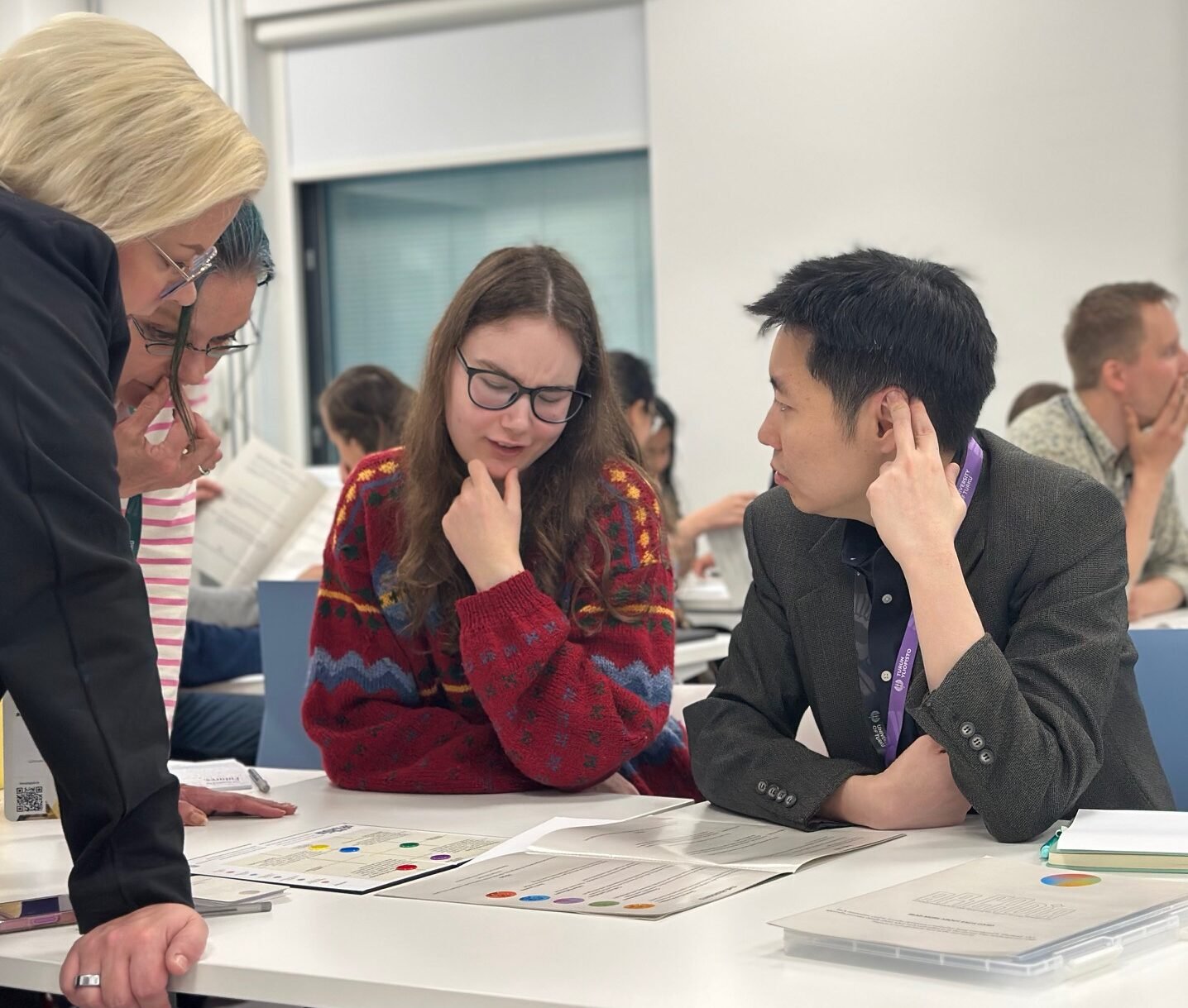
In this case study we go over why this game exists in the first place, how it forms the basis of a planning engine that is built out of serious game design, strategic foresight, and participatory design methodologies. Finally, we cover why Arcadia itself may not be appropriate for you but you can bet your R&D department roadmap that a version built for you is.
What were you thinking?
Arcadia started with years of community-based research in Thailand—most significantly the Bangkok Design Week 2020 study on urban resilience, conducted in partnership with local organizations and residents navigating rapid urban change.
We expected to hear about policies, services, and economic pressures. And we did, sort of. The real finding was all about place: a park or a temple can help a person feel good, but in contrast, the majority of other spaces, no matter how glamorous or well designed, contributed to feeling bad.
That is an oversimplification; the reality is that local cultures and beliefs intertwine with how a person experiences a place. One drastic example that we saw over and over again is how many places kept people, specifically kids and young adults, from being able to express themselves. Culturally, Thailand is known as “The land of smiles” but many spaces transform those into fake smiles.
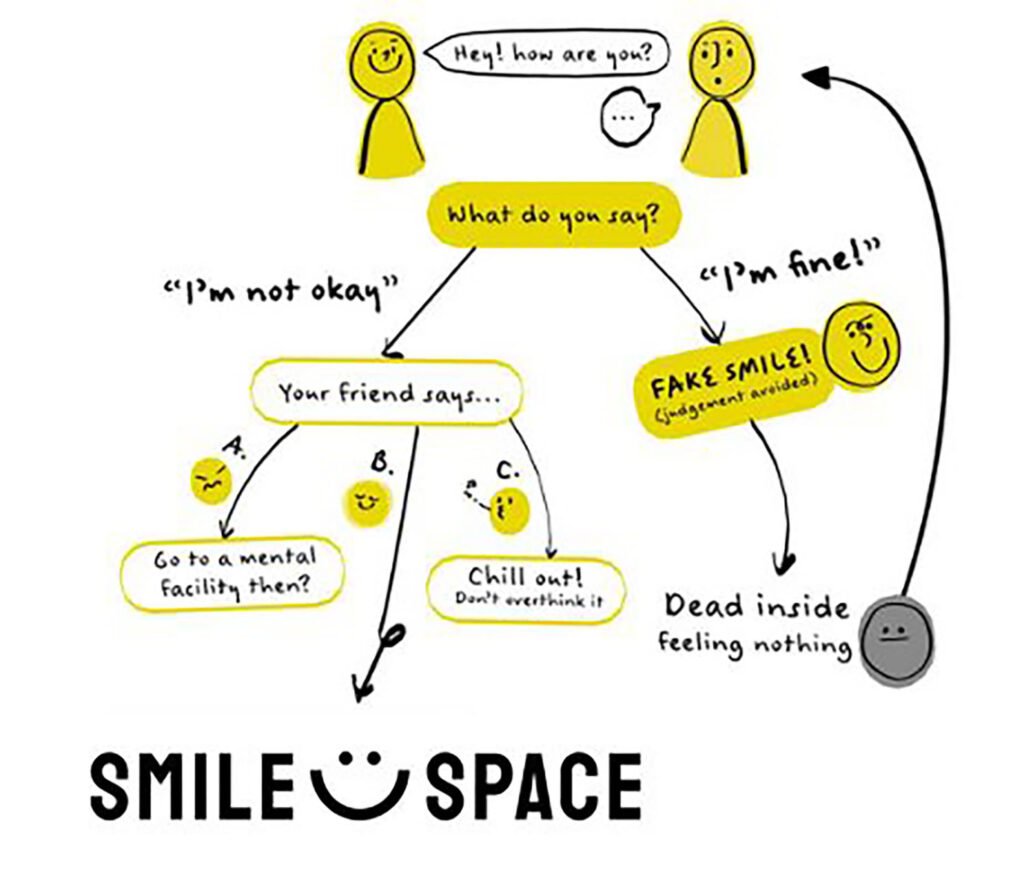
We even made an entire initiative around this idea called Smile Space (funded by YSEALI Seeds for the Future in 2021 and supported by Cultural Vistas) which was an online space and series of public exhibits designed to overcome unhealthy self-expression habits. That work went on to influence strategy at the social teen program Mindventure and the mental health campaign “Unknown Together,” sponsored by Facebook and UN Thailand.
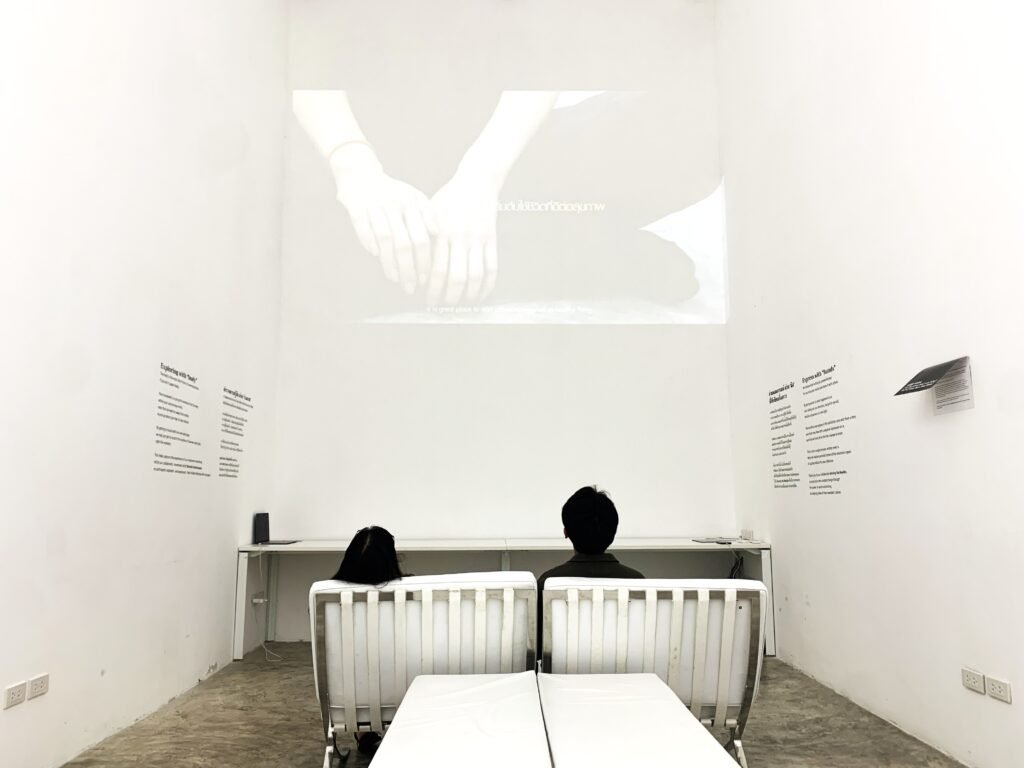
So this is the substrate for Arcadia, the serious game we created: futures are emotional, spatial and cultural.
TIJ needed a game worth playing
Thailand Institute of Justice wanted to make strategic foresight accessible for justice policy, particularly concerning children and youth. They had a specific problem: how do you get policymakers and young people to think together about futures when they hold different kinds of power, different expertise, and different stakes?
Traditional foresight methods like scenario planning, horizon scanning, trend analysis produce rigorous outputs, but they require expertise to facilitate and interpret. Participatory workshops generate energy and engagement, but often lack analytical structure; people leave feeling heard without producing anything durable. Neither approach adequately handled the power asymmetries built into justice policy: adults designing systems for children, experts speaking for communities they don’t inhabit.
TIJ needed an instrument that could hold the rigor of foresight methodology while remaining genuinely accessible to people without prior training. A tool that allows people to use strategic foresight while considering policies important to Thailand, in a way that reflects the Thai context, without needing an advanced degree. More importantly, they needed an instrument that would make them care about what strategies actually mean for the people and places affected by them.
So we built a great board game engine
Arcadia is a cooperative board game where players build a future city together while attending to multiple stakeholders with different levels of power and vulnerability. The design synthesizes three methodologies, each contributing something the others lack:
Strategic foresight provided the overarching temporal structure. Players wield drivers of change: mostly policy reforms in this case, respond to uncertainty events, and balance desired scenarios with what is present today.
Participatory design shaped how we built the game itself. We didn’t design Arcadia for youth and policymakers; we designed it with them, through months of sessions with TIJ staff and members of the Children and Youth Advisory Committee. The specific drivers, stakeholders, and artifacts in the game emerged from that collaboration and past research.
Serious games enabled the cooperative structure where players must negotiate shared outcomes rather than compete for individual wins. The serious part of the game means that the game is fun and provides a deeper moral that can be applied outside of the game.
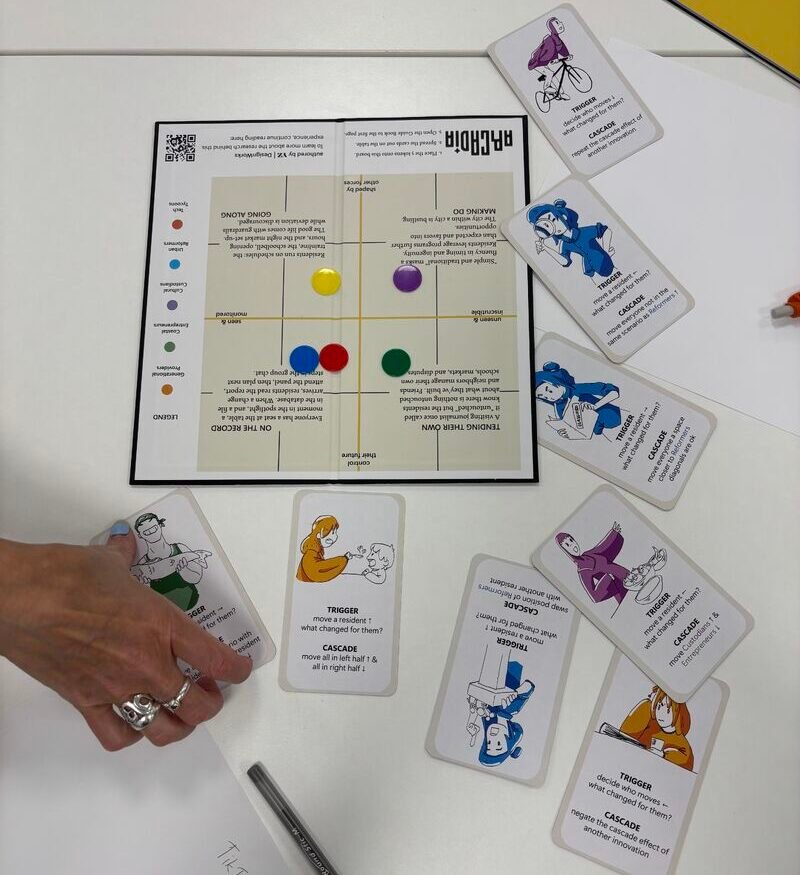
How the Mechanics work
The game’s core loop asks players to make decisions that affect multiple stakeholders simultaneously.
Players cannot optimize for a single group; helping one constituency creates consequences for others. This reflects what the Bangkok research showed us: people experience the same urban environment very differently depending on their position in social and spatial hierarchies. A new development might mean opportunity for one resident and displacement for another. The game makes that multiplicity impossible to ignore.
Policy discussions often fail because participants can’t see how decisions cascade through systems. In Arcadia, choices accumulate and the scoring mechanism provides immediate, tangible feedback on systemic effects and allows players to glance ahead. Players experience how well-intentioned decisions can produce unintended harms and can strategize around them.
The results are sometimes uncomfortable
In our previous research into how justice works in Thailand, we have discovered that:
Youth imagine tangible reality. Youth talk about the environments where justice happens and what it means to be and feel in those spaces.
Adults imagine procedures. Adults talk about communication protocols, training curricula, reporting mechanisms. They thought about how justice procedurally works.
The difference is that adults, especially if they have a lot of training and experience in policy or legal procedure, may systematically overlook the spatial and environmental dimensions that young people experience as central. This is the exact tension that brought us here in the first place. Policy-centric decision making created fake smiles; we want more people-in-spaces perspectives because this will actually create areas that serve emotional and psychological needs through self expression.
We can see this shift happening at the end of the game:
Even teams that win the game by creating a fair, balanced, and just city are not always comfortable with the decisions that brought them there. The game would not allow players to treat policies as abstract levers. Every policy had to land somewhere real since people were playing with groups they could empathize with, in locations, with situated events. Playing some cards was the right move at the time, but thinking about what they actually mean, especially in combination with other plays, sometimes creates uneasy feelings. The policy was right at the time, but in hindsight, it feels wrong. We see this tension shift during play. Even teams that “win” by creating a fair, balanced city are often uneasy about the decisions that led them there.
What’s happening in these moments is a change in imagination. Policies that once seemed reasonable begin to feel insufficient. Futures that looked good on paper become harder to defend once their lived consequences are experienced. In practice, the power of a serious game lies less in what it represents than in how it reorganizes judgment. By reshaping what decision-makers attend to (and what they consider plausible) a well designed game can alter how decisions are reasoned about and justified.
Validation
TIJ curriculum integration. The game is now a regular component of TIJ’s Future Thinking for Social Justice program, delivered to policymakers, practitioners, and youth delegates. Repeated use across facilitator styles and participant groups has allowed iterative refinement.
APF Ingenious Foresight Awards 2025. The Association of Professional Futurists recognized Arcadia in multiple categories, including Experiential Futures and Participatory Futures. Peer recognition from foresight professionals suggests the methodological synthesis holds under scrutiny—the design is not merely engaging but contributes something to the field.
Adaptation to new domains. The game engine is currently being adapted for AI safety and security contexts, testing how the core mechanics transfer to different strategy challenges while remaining effective.
Should I play this game?

You should play it to understand the engine behind the game. Arcadia itself is not a framework, and it wasn’t designed to become one. It emerged from a specific place, over time, in response to constraints and research. It is ultimately a game where the rules, the cards, and the outcomes make sense for Thailand. The drivers that players use, the uncertainties they face, and even the citizens who they are helping, are particular. Then it reshapes judgment by changing what people can imagine while decisions are being made.
The engine beneath it all is worth exploring. How it makes previous data accessible, how it reinforces different time horizons with an evolving point system, and creates dynamic conversations across players with different experiences, all of it can be made to fit your context.
The key that makes it work is the combination of well designed, mixed-methods studies to understand the context, using a participatory approach to refine the intricate details, and then combining it with this engine using serious game design principles. The extra spice comes from distilling a few choice tools, carefully chosen from strategic foresight, that then allow players to imagine something new in a way that feels more real.
Arcadia exists because we spent years understanding how communities in Thailand actually experience space, risk, and possibility because we know enough about foresight, participatory design, and serious games to synthesize them into something that works where off-the-shelf methods don’t.
The case for Arcadia isn’t that it’s clever. It’s that deep community understanding combined with methodological fluency produces instruments that reveal things other approaches miss.
Sophisticated Research.
Nuanced results.
617-807-0047
yuri@yzdesignworks.com